CLaMS Data for the study on potential ozone loss in the mid-latitude lowermost stratosphere
Introduction
This data repository provides access to results of the simulations conducted with the Chemical Lagrangian Model of the Stratosphere (CLaMS) for the study by Robrecht et al. (2020). This study is aimed to assess the potential of heterogeneous chlorine activation causing immense ozone destruction in the mid-latitude lowermost stratosphere in summer as a side effect of sulfate geoengineering. In general, the potential application of sulfate geoengineering is aimed to keep the global mean temperature from warming by injecting sulfur particles into the stratosphere. In this study, the likelihood for heterogeneous chlorine activation to occur in the mixing layer between tropospheric and stratospheric air above central North America is determined as well as its impact on column ozone and ozone in the considered region for conditions today and in future assuming climate change and the additional application of sulfate geoengineering.
CLaMS box-model simulations are used to calculate chlorine activation thresholds, which determine temperatures and water vapour mixing ratios leading to heterogeneous chlorine activation for a specific trace gas composition and sulfate abundance. CLaMS box-model simulations are initialized based on results of the Geoengineering Large Ensemble Simulations (GLENS). GLENS is aimed to study potential risks and benefits of sulfate geoengineering and comprises two scenarios for the years 2010--2100: a climate change scenario following the RCP8.5 pathway and a geoengineering scenario, where sulfur is injected into the stratosphere beginning from the year 2020 to keep the global mean temperatures from warming. Through comparing the chlorine activation thresholds calculted from CLaMS simulations (lines in the shown figure) with the relative distribution of occurrence frequency in temperature and water vapour space in GLENS(colour scheme in the shown figure)for both GLENS future scenarios and different decades, the potential impact of heterogeneous chlorine activation on ozone in the mid-latitude lowermost stratosphere is analysed for conditions today and in future. In the study of Robrecht et al. (2020), the decades 2010-2020, 2040-2050 and 2090-2100 are considered, resulting in 5 cases: The cases Control20102020, Control20402050 and Control20902100 based on the GLENS climate change scenario and the cases Feedback20402050 and Feedback20902100, which are based on the GLENS geoengineering scenario.
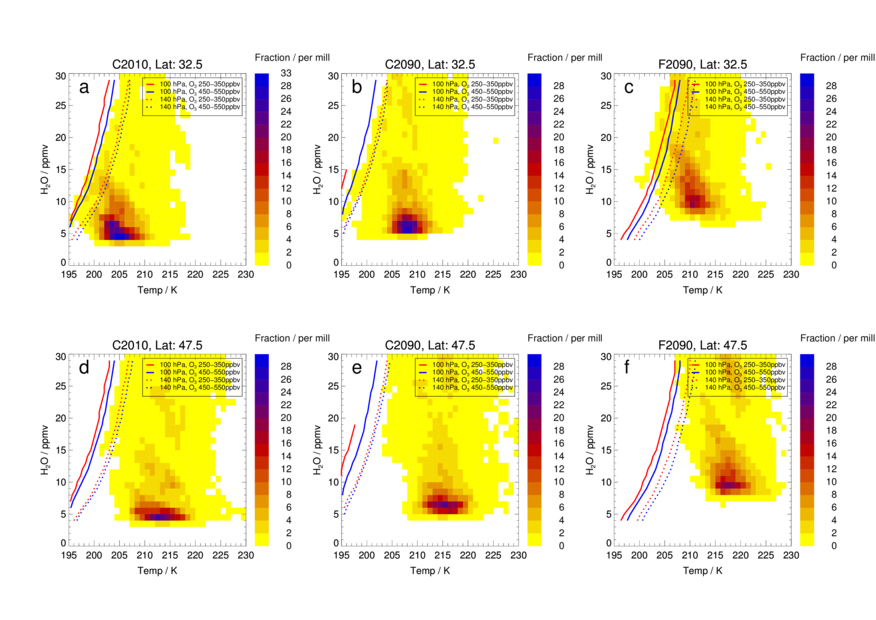
CLaMS Data for the study on potential ozone loss in the mid-latitude lowermost stratosphere.
CLaMS box-model simulations are performed for each case and initialized based on the GLENS results in the mid-latitude lowermost stratosphere above central North America. Since the temperatures, water vapour mixingratios and the trace gas composition change strongly in this region, GLENS data are divided with respect to the latitude range, the pressure level and the ozone mixing ratio. The latitudes, pressures and the ranges of the ozone mixing ratio used in the CLaMS simulations are given in the table below. CLaMS simulations are performed for each combination of latitude, pressure level and ozone range. For calculating chlorine activation thresholds from CLaMS simulations, various simulations with the same trace gas composition but different temperatures and water vapour mixing ratios are conducted. Hence, for each case and each combination of latitude, pressure level and ozone range, temperatures are scanned in a range of 195-220 K (1K steps) and additionally water vapour mixing ratios between 4 ppmv and 30 ppmv (1 ppmv steps).
| Latitude / °N | 32.5, 37.5, 42.0, 46.0 |
| Pressure level / hPa | 80, 100, 120, 140, 160 |
| Ozone range / ppbv | 150 - 250, 250 - 350, 350 - 450, 450 - 550, 550 - 650 |
| Temperatures | range from 195 K - 224 K in steps of 1 K |
| Water vapour mixing ratio | range from 5 ppmv - 30 ppmv in steps of 1 ppmv |
Data access
The resuts of the CLaMS chemistry simulations can be accessed here.
The structure of the data in this repository is:
- There is one *.zip-file for each case considered:
Control20102020 → conditions at the begin of the 21st century
Control20402050 → conditions at the mid of the 21st century assuming climate change
Control20902099 → conditions at the end of the 21st century assuming climate change
Feedback20402050 → conditions at the mid of the 21st century assuming sulfate geoengineering
Feedback20902099 → conditions at the end of the 21st century assuming sulfate geoengineering
- in each *.zip file, there are 25 netcdf-files named in the structure chem_{case}_o3_{ozone-range}_{pressure level}hPa.nc. The possible ozone ranges and pressure level of all simulations concluded in one file are given in the table above.
- each net-cdf file comprises 3240 single CLaMS box-model chemistry simulations differing in the assumed latitude, water vapour mixing ratio and temperature. The different latitudes, temperatures and water vapour mixing ratios assumed for a simulation are given in the table above.
Legal Notes
The data sets provided on this site are licensed under a Creative Commons Attribution 4.0 International License. You are free to share the material in any medium or format and adapt it for any purpose, even commercially. You must give appropriate credit, provide a link to the license, and indicate if changes were made. You may do so in any reasonable manner, but not in any way that suggests the licensor endorses you or your use. You may not apply legal terms or technological measures that legally restrict others from doing anything the license permits. The licensor cannot revoke these freedoms as long as you follow the license terms. The data are distributed in the hope that it will be useful, but without any warranty. Please follow the link to see the terms and conditions of the license:
We kindly ask to contact the authors, if you use these data.
Reference
Citation, if the data are used in publications:
Robrecht, S., Vogel, B., Tilmes, S., and Müller, R.: Potential of future stratospheric ozone loss in the midlatitudes under global warming and sulfate geoengineering, Atmos. Chem. Phys., https://doi.org/10.5194/acp-21-2427-2021, 2021.
Contact
Please do not hesitate to contact us if you have any further questions:
Forschungszentrum Jülich
Institute of Climate and Energy Systems - Stratosphere (ICE-4)
52425 Jülich
Germany
Sabine Robrecht: sabine.robrecht@dwd.de
Bärbel Vogel: b.vogel@fz-juelich.de